Posted in:

The Medici: People of Mugello - Family Portraits from the Uffizi Galleries

Publication Date  Friday, March 15, 2024
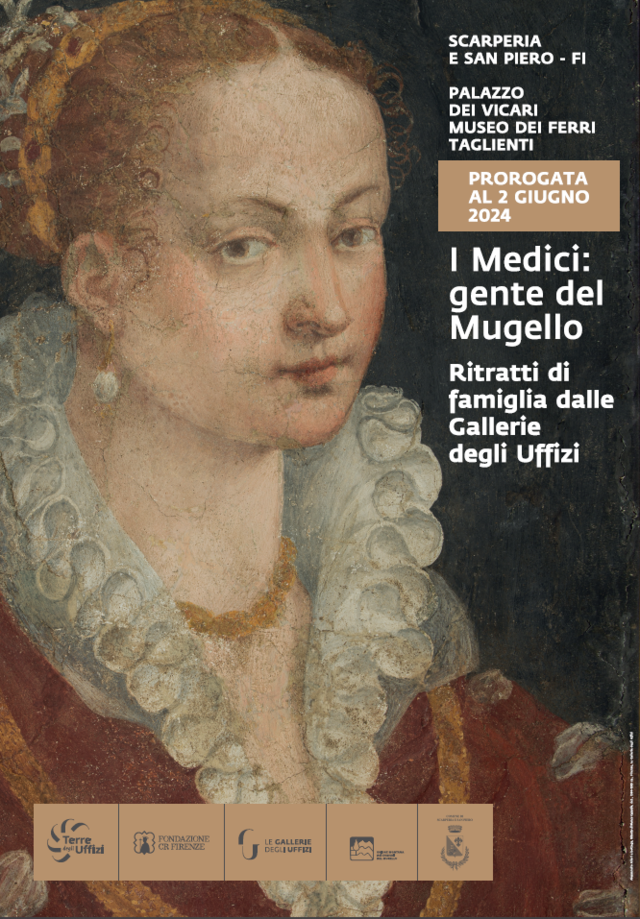
Playbill The Medici: People of Mugello - Family portraits from the Uffizi Galleries

Exclusive Exhibition in Scarperia e San Piero ~ 19 May 2023 - 2 June 2024

You still have time until 2 June 2024 to visit the exhibition “The Medici: People of Mugello - Family portraits from the Uffizi Galleries” at the Museum of Cutting Tools ('Museo dei Ferri Taglienti') in Scarperia e San Piero. This exhibition is organised by Fondazione CR Firenze and the Uffizi Galleries, as part of their respective projects 'Piccoli Grandi Musei' and 'Uffizi Diffusi'.

Inside the sumptuous Palazzo dei Vicari in Scarperia, you will find four paintings depicting members of the Medici family on display, recalling the deep-rooted presence of this family in the Mugello area. Brought directly from the Uffizi Galleries, these portraits were painted by eminent Florentine artists between the 1630s and 1880s.

  • We find a young Cosimo I de' Medici portrayed by Ridolfo del Ghirlandaio: although little more than a ten-year-old boy, he already appears proud and aware of his social position, as shown by the sumptuous robes and the coat-of-arms clearly visible at the top right, with the inscription "cosmo med".
  • The portrait of Duchess Eleonora, Cosimo's wife and daughter of Don Pedro de Toledo, viceroy of Naples, was painted by Lorenzo Sciorina, a student of Bronzino. Sciorina presents a slightly different version of his master's famous work, which is currently housed at the Uffizi. The princess wears an elegant dress and, whereas in Bronzino's version she is depicted with her second son, here she is pictured accompanied by Garcia, her eighth child who died prematurely of malaria.

  • Finally, the portraits of Francesco I, depicted here in his thirties, and his second wife Bianca Cappello are noteworthy both for their intense expressions and the attention to detail in the background, fabrics and ornaments. Painted by artists from the circle of Santi di Tito and Alessandro Allori, the pictorial style of the two works reflects the prevailing artistic trends in Florence towards the end of the century. A curiosity: the portrait of Bianca Cappello was originally frescoed in the presbytery of the church of Santa Maria in Olmi, as the Grand Duchess was particularly devoted to the image of the Virgin venerated in this church; the painting was later removed to be transferred to the Florentine galleries in 1871.

This exhibition highlights the Medici's historical connection with the Mugello region. From the mid-13th century, the Medici family invested in real estate along the border between Romagna and Tuscany: the first acquisitions were made by Averardo de' Medici between 1260 and 1264 and then others by Giovanni di Bicci, including the stately home of Trebbio. During the course of the 15th century, the Medici further extended their property in the Mugello, culminating in the purchase of Cafaggiolo in 1443. By the middle of the 15th century, the Medici family controlled a vast expanse of land.

Cosimo the Elder commissioned the architect Michelozzo di Bartolomeo to transform the residences of Trebbio and Cafaggiolo into sumptuous "villas", thus highlighting the economic interests of the Medici family and their passion for hunting in the area.

Before becoming Duke of Florence, Cosimo I de' Medici spent part of his youth in the castle-villa del Trebbio together with his wife Eleonora di Toledo, also occasionally staying in Cafaggiolo. With the arrival of Francesco I, attention shifted to the road connecting the Mugello to Florence and the villa di Pratolino was built in 1568. This villa included the famous 'garden of wonders' created by Bernardo Buontalenti for the prince, his beloved Bianca Cappello and their numerous illustrious guests.

Documentary evidence from the Municipal Archives of Scarperia, also displayed in the exhibition, confirms the constant influence of the Medici even within the institutions of the Mugello.

"The Uffizi pays homage to the Mugello, where - you could say - everything began: this is where the Medici came from, who were not only very clever financiers and entrepreneurs, but also incredibly shrewd collectors and patrons," says Uffizi Galleries director Eike Schmidt. "There would be no Uffizi without the Medici. The exhibition combines precious documents with portraits of the main representatives of the Family Line in the 16th century: and it is exciting to think that these names, these characters, corresponded to a strong love for an area that is today relatively undiscovered, and perhaps for this reason still so authentic, so rich in art and, like Scarperia, even impressive".


For more information about the exhibition, contact the Palazzo dei Vicari: +39 055 8468165 - +39 353 4364738 / informazioni@prolocoscarperia.it


In partnership with Trading Estate Service Srl